Showing posts with label Project LEBANON. Show all posts
Tuesday, June 28, 2011
14 Fruit Picking
The Beqaa valley is one of the areas in Lebanon that are extremely isolated, rather dry in comparison to all the beauty that is in Lebanon, and simply fascinating considering the above two mentioned points. I have personally never been to the Beqaa valley and not knowing the area made it that more interesting, but to all things good there is a bad. The area is filled with army men, and infested with illegal crop, and hence the hostile residence that come with illegal anything. But all and all the Hike was fun and the Cherry Picking WOW!

Friday, June 17, 2011
3b Pangea
YO! I am back with news on the beach front. I recently went to Pangea, which is also in Jiyeh, but closer to the Saida coast than Lazy B. There is much hype about Pangea, but I would have to say its not as exciting as it seems! Though all the necessary amenities are there, it lacks a wow factor.
Following the beach we went to a fish restaurant in Saida, its kind of high class and really nice, and was well worth the visit.
Tuesday, June 14, 2011
7 Byblos
An hour of driving and we arrived at Byblos without a crux in the road, it was without a doubt a smooth and comforting ride. We sung, we danced, and we swerved across lanes in true Lebanese style. Upon arriving to Byblos, my friend and I had to catch our breath from the heat. The humidity turned our cheeks red and made our stride heavy, but it would soon be worth all the discomfort. Entering the old town, one would never have imagined that these were the streets of some of the most ancient of ancient civilizations. Bars, Clubs, Restaurants and Souvenir shops line the pristine cobble stone streets and alley ways of Byblos. The place is clearly a modern rendition of an older time. And though that has its positives, I was not extremely impressed. Here are some pictures.
What was impressive was the Crusaders castle itself, surrounded by Phoenician and Roman ruins it reaps of Lebanon's strategic location in the world. An Ottoman railroad, from what I gather, was built on top of the ruins. There are sections of the ruins which surround the Castle, which has a view of the waterfront, that are lined by the remaining parts of the railing of the railroad which splits into two diverging rails that move into the Phoenician ruins from one side and Roman ruins from the other. Here is a picture.
Here are pictures of the Castle:
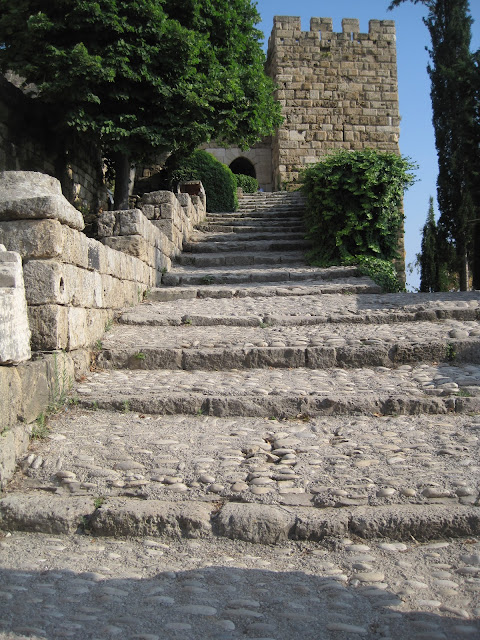
Here are pictures of the ruins around the castle and the sea:
If you are into history this place is like an orgasmic experience, no kidding, the whole area is marked off with boards describing the ruins, temples, coliseums, and houses of old. Here is a pic.
Finally, we arrived to the high way where we returned home swerving through lanes on the return just as if we were on our way to Byblos. The trip was eventful, and highly entertaining, a must if ever you visit Lebanon.
Friday, June 3, 2011
13a The Silk Museum
Recently I went to the Silk Museum, where I discovered Lebanon's history with silk, which dates back to the Phoenicians.
Though there is no real relevance between this and the silk Museum, there is a movement of predominantly Christian Lebanese who claim to be Phoenician and not Arab. This dates back to the civil war Lebanon experienced in the 70's and a good ways into the 90's. Those who countered the Palestinians and the Arab Nationalist causes, claimed that they were destroying the nation by using Lebanon as a battle ground against Israel. This they would not tolerate; interestingly they are the same people who initially supported the French Mandate on the grounds that Lebanon was a predominantly Christian country. Now they internalize their struggle and rationalize their culture as being unique to those of the region. It really is a pity that faith can be such a wedge between people, when (especially Christianity) was meant to harbor peace and love between all.
Though all the groups in Lebanon share a history of militancy, today it is only Hizballah that is actually a militia. Many questions arise as a result of their military presence in the country. For one, who will protect Lebanon? The government's security forces are not equipped for securing Lebanon's borders! For another, who will securely protect and represent the Shiite community. They are underrepresented in most everything in the country and this imbalance is largely due to a class struggle they have to cope with. (Though some might disagree with me on this last note, I would say there is a historic precedence of over representation of the Christians in Lebanon, and today an over representation of the Sunni in Lebanon) No balance has been properly found or made, even though the system is built on an assumed thread of equality. It inherently categorizes people, and thus creates power struggles between these categories, which debunks and destabilizes the balance of power it is presumptively based on.
What a mess!?
Though there is no real relevance between this and the silk Museum, there is a movement of predominantly Christian Lebanese who claim to be Phoenician and not Arab. This dates back to the civil war Lebanon experienced in the 70's and a good ways into the 90's. Those who countered the Palestinians and the Arab Nationalist causes, claimed that they were destroying the nation by using Lebanon as a battle ground against Israel. This they would not tolerate; interestingly they are the same people who initially supported the French Mandate on the grounds that Lebanon was a predominantly Christian country. Now they internalize their struggle and rationalize their culture as being unique to those of the region. It really is a pity that faith can be such a wedge between people, when (especially Christianity) was meant to harbor peace and love between all.
Though all the groups in Lebanon share a history of militancy, today it is only Hizballah that is actually a militia. Many questions arise as a result of their military presence in the country. For one, who will protect Lebanon? The government's security forces are not equipped for securing Lebanon's borders! For another, who will securely protect and represent the Shiite community. They are underrepresented in most everything in the country and this imbalance is largely due to a class struggle they have to cope with. (Though some might disagree with me on this last note, I would say there is a historic precedence of over representation of the Christians in Lebanon, and today an over representation of the Sunni in Lebanon) No balance has been properly found or made, even though the system is built on an assumed thread of equality. It inherently categorizes people, and thus creates power struggles between these categories, which debunks and destabilizes the balance of power it is presumptively based on.
What a mess!?
THE SILK MUSEUM
| :) |
| These are the worms that start off really small and eat till they reach triple and then some there weight. |
| When they have reached the right size (they only live for a month) they begin creating thread around there bodies, cocooning themselves inside. |
| This is what they look like when fully cocooned, they die inside the cocoon, turn into hard rocks! |
| Then they wash and process the cocoon shells, slowly extracting the string from the cocoon (remember this is how the Phoenicians did it, not how its done today). This takes several men to process. |
| Finally they stretch out the string and process it into silk. One silk scarf can take up to 10,000 cocoons. |
| The museum is lined with pictures of the old days and how the silk was made in those days! |
| It also has a garden that has such beautiful flowers and fruit trees! |
| And a view of Beirut from afar with the sea right in front of it. The museum is in Bsous! |
| Finally, I found my favorite wild flower growing in the mountains (its a resiliant bugger!) |
Subscribe to:
Posts (Atom)