Showing posts with label Beirutification. Show all posts

Friday, May 27, 2011

4g Achrafiah

I have a small passion for flowers and trees. There beauty astounds me, and the color is just so magnificent. This is one reason why I take so many pictures of them.

Thus, today's post is dedicated to this one tree that grows flowers in spring that can be seen predominantly (or more often then not) in Eastern Beirut. Eastern Beirut is predominantly Christian and includes Bourj Hammoud, which is actually a little outside of Beirut, and Achrafia which is between the Bourj and Western Beirut.

A Little History Lesson for you about Beirut:

Lebanon was liberated in 1943 from the French Mandate imposed after World War II when the Ottoman Empire was split up by the Allied Forces.

During the cold war between Russia and America, the East and the West, specifically prior to the 75 civil war, Beirut was also divided between East and West, Western Beirut supporting the nationalist Eastern Movements, and Eastern Beirut generally following the American West and its allies! Till this day Service (our version of public transport) Drivers mark off there driving routes according to Eastern and Western divides. This has some geographic reasoning, distance between East and West and the general ambiance of both regions varies greatly. You can see these differences in the pictures as well as in the flower tree. The only exception is the street driving away from Western Beirut towards Eastern Beirut (Spears), it has the most concentrated grouping of these trees that I have seen in Beirut.

This is kinda why I like it so much, for one the larger the tree the older it is, we are talking 50, 60 years old. So it too has experienced and lived Lebanon's Violence. And it landmarks Lebanon's differences, while portraying them as something BEAUTIFUL. But most of all it emphasizes the in between nature of the Lebanese community with its trees covering the Spears Highway as if to protect it from hatred. It is in my opinion a treasure that we take for granted.


One of the younger trees! In the Sodeco area right into Achrafia and Mathaf!


The streets are all tighter in Achrafia than they are in West Beirut. Houses literally at every turn and narrow narrow alleyways!


In between East and West Beirut, on the way to Hamra

On the wall to your Left you see Banners promoting the removal of the Tafia/Sectarian System following the Arab Spring Revolutions. And right above them are the flower trees leading you into East Beirut. They cover the whole street, and overlap from both ends of the street, its breathtaking!  

Wednesday, May 11, 2011

4f Bourj Hammoud

Bourj Hammoud is one of the many places outside of Beirut but close enough to it where you can enjoy a good visit now and then! There is this wonderful DVD store there where I buy my Movies from. Plus there are all sorts of shopping centers filled with Lebanese produced (and really good quality) stuff.

Bourj Hammoud is a part of the Metn Mohafaza or district, and is renowned for being populated by Armenians escaping genocide from the early twentieth century. The Aremnians are a significant part of the Lebanese fabric, most of the second generation Armenians speak Arabic, French, English and of course Armenian. They hold strongly to their heritage, which is a plus for Lebanon as it encourages the Lebanese to learn to be tolerant of Others. They are not discriminated against as much as the Kurds or the Ethopians/Migrant workers in the country, but are not exactly embraced either. They pretty much live on the cusps of Lebanon, in in between spaces, and as in between figures, not here nor there.

One of the largest Armenian political parities in Lebanon is Tash Nak, they are supporters of the March 8th movement (pro Hizballah). There rivals are Hizb al Henchag or the Social Democrat Hunchakian Party, and Ramgavar.

As usual these pictures are my own!


check out the Armenian, French, Arabic, and English-LOL


Saturday, May 7, 2011

4e Ras Beirut Hamra

Hamra Cafe has a new slogan that goes "Then. Now." with pictures of Piccadilly (a street perpendicular to the center of Hamra Street)! There was an artist when downtown was first renovated who had taken mass pictures of the downtown area before it was reconstructed and placed them exactly parallel to the new ones. I saw an art exhibit at the Tate Modern when I was living in London of an Arab Artists renditions of the Lebanese civil war with pictures of car explosions on the streets compiled from 1975 to date.

Lebanon's history is not a sympathetic one to the ears. It is as bloody as any history should be, and there is no surviving winner, so it is not as concise. Hamra in so many ways epitomizes the Lebanese experience as it is one of the few areas (though this is changing as the area is being gradually gentrified) that is for everyone.

Though this may be a biased perspective,  I do believe most people will agree that Ras Beirut is more diversified than Greater Beirut and that Hamra is the most diversified area in Ras Beirut. I say this carefully because it can be really difficult to measure the way the city is cut up and what area belongs to what sect especially in Ras Beirut, here there tends to be an assumption that the whole area is very Sunni, (city spaces in Lebanon usually are) but the area: is a shopping district, is filled with schools, is residential and buisness oriented at the same time. It caters to everyone's demands and needs, thus i will walk on egg shells and say the area is not purely Sunni.

I am afraid there are not enough statistics to validate my claim, and if there were their reliability would be questioned! If I am right about Hamra, I hope this is the outcome of the rest of Beirut by the time I pass.


(Hamra means Red in Arabic, and on a street parallel to Hamra is a cafe called Le Rouge, which means the Red in French, perpendicular to it on a corner is Olio, a pizza place designed and surrounded by green paint and trees, I find the mesh mash to be highly witty)
:)

4d Ras Beirut Bliss

The Comparison is so worth it! I am so surprised that in fact not as much has changed since the 70's until now as I have would have thought. There is usually more traffic, but I did my best to avoid taking pictures of cars (UGLY)!


Tuesday, May 3, 2011

4c Beriut Down Town Continued

Though I don't think I need to explain or justify myself, I am doing so because I don't want people to get the wrong impression. For one, the Down Town pictures of what was and what is are a representation of how Lebanon has changed since its glory days (sarcasm). The response to my post is a representation of how it hasn't changed.

I received some comments about how biased I may be to the Sunni Lead Hariri government who have supported and sponsored Solidere, the corporation responsible for reconstructing the downtown area.
Solidere is mostly a private corporation, though its origins were created for public purposes (and are still of public concern), it gradually evolved into a more privatized business. One that Hariri and his people encouraged via the laws governing Solidere. Ohrstrom writes in the Daily Star,
Solidere was established by the government through CDR [the Council for Development and Reconstruction] and is regulated by two public statute laws but has taken the shape of a commercial company. It has been supported by the government and given about $1 billion in exemptions, and half of the area of Solidere is municipal property. 
Since its relatively none humble beginnings, Solidere has evolved into stock oriented business, those who owned land in downtown area received stocks in Solidere as compensation for their deeds. Many of these people were forced into selling their stocks for prices less than the value of their land, which created much controversy around Solidere. Not to exclude the fact that many people living/squatting in the area at the time were forced out of their homes. 

Hence the critics began to reign down on the renovation of the downtown area. The criticism ranges from corruption charges, perpetuating historic civil war amnesia charges, increasing debt charges, destroying archeological sites charges, excessively commercializing Beirut charges, and increasing the class and sectarian divide charges. All are valid. 

Hariri had the largest amount of stocks invested in Solidere. Thus clearly indicating a bias in his political status as his financial interests are implicated in the countries renovation. People saw this bias and commented, calling him
Ammar hajar wa dammar basher – he who built the stones and destroyed the people. (Craig Larkin)
Now that he has passed,  the car explosion that took him, and the cedar revolution that has followed make him a symbol of sorts. A symbol of freedom and of liberalism. His name and status is untouchable, people do not accept criticism of the Man anymore. Though he was as fallible and as human as any of the current politicians to date.

Regardless of this, Solidere still persists on and is still renovating the region from what it once was. The area is undoubted beautiful with cobble stone roads, four story buildings, a clock tower, several Souks (Markets) ranging from the really absurdly expensive to the moderately expensive, and gorgeous mosques and churches laden with chandeliers and bells and prayer calls alike.  It is a distinct indication of Lebanon's Commercial oriented history. While representing Lebanon's multifaceted camilion like quality. All of which is topped off with Roman ruins. I personally find the area mesmerizing, and a tribute to what shit loads of money can do to any country. 

WHAT I believe is that we have to face the fact that it's far too late to criticize Solidere (though they still need to be held accountable and responsible, and the laws need to be made clear about what its regulations and policies are!) The face of Lebanon is changing, as is the world, and though it is becoming more and more materialistic and divided by class; it is also shrinking and breaking down barriers that once existed. Everything needs to be taken with a grain of salt, regardless of its weaknesses or strengths. 

Monday, May 2, 2011

4c Beriut Down Town


THE PICTURES SPEAK FOR THEMSELVES
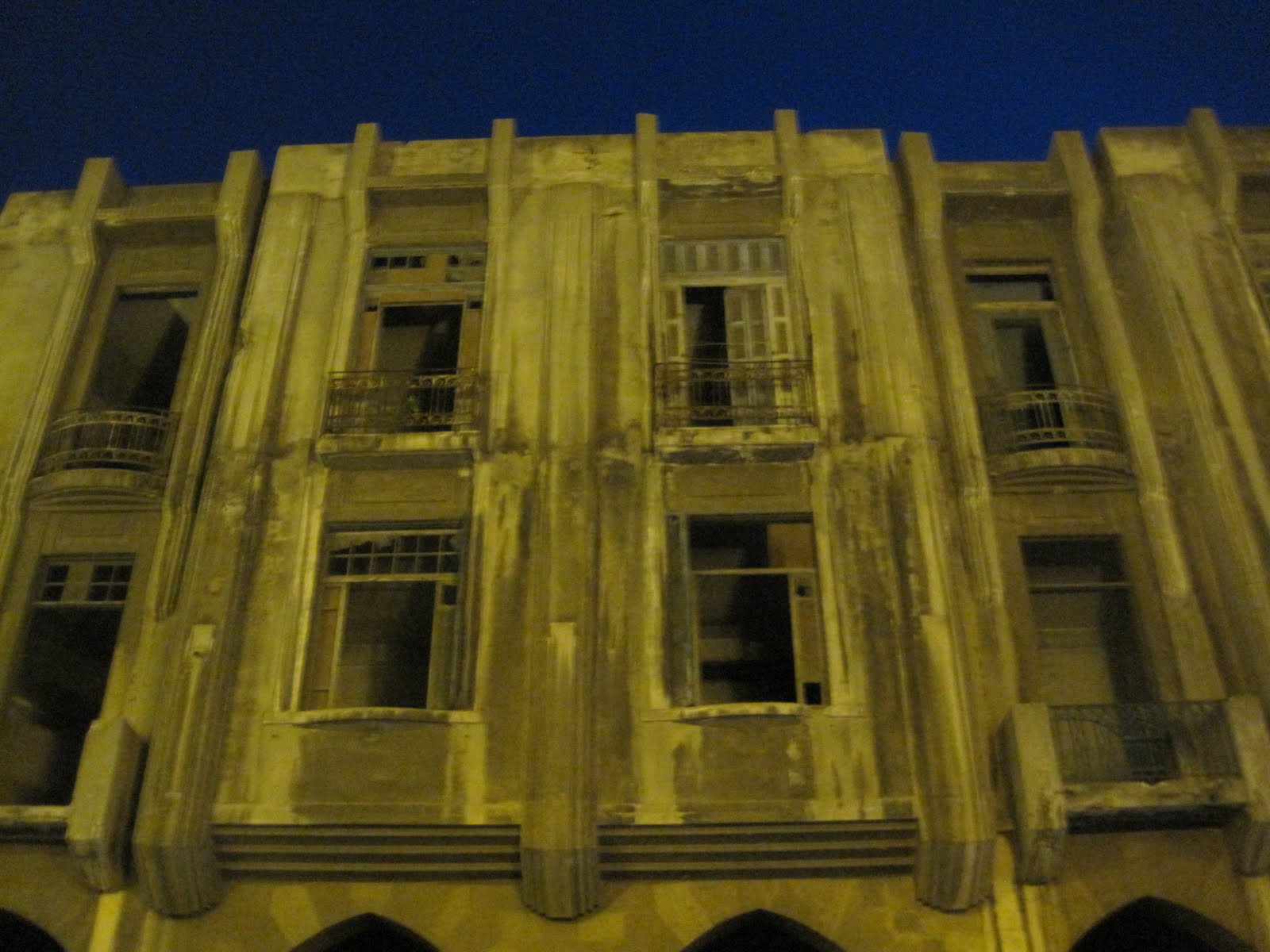
Building Being Renovated Till Now
Church and Mosque


Beirut Now
Beirut Then


Beirut Now
Church and Mosque
Beirut Then
BEIRUT NOW

Saturday, April 30, 2011

4b Ras Beirut Cornich

I know I have a thing for the beach front, anyone who knows me knows its because I enjoy a good Shisha more often than not. But there is so much more to it than just that, there is such a distinctive sense of history in the water and on the coast line, and I find it mesmerizing. (On a side note, I was recently told that my blog doesn't reflect the negative dynamics of the country. Corruption, Sectarianism, Stagnation, Racism, Gender biases, Unemployment, and an inability to move towards change: are a few of the problems. I am a positive person, but there are without a doubt key issues at hand. We still haven't formed a functioning government since Mikati came on board as the new Prime Minister. People are unable to work as a result of this, and its aggravated by the ongoing threat of Foreign influences in the country. Not to mention both Israel and Syria are unfriendly and in the case of Syria extremely volatile. I will try being less biased and rosy in future posts about this, but sometimes I just want to escape the reality and enjoy the pleasantries. Especially now that I am leaving the country.)

Thursday, April 28, 2011

4a Ras Beirut Verdun

I feel Beirut comes in two sectors:: Ras Beirut, and everything else. Ras Beirut is mostly composed of Verdun, Concord, Clemanceau, Hamra, Bliss, and the Corniche. All of them are a walking distance from one another. Everything else needs a car to reach from Ras Beirut. They include: Marlias, Karacol al Druze, Ramlet al Bayda, El Zarif, El Mazraa, Jnah, Ouzai, Solider, Gemazzye, Mathaf, Badara, Tayouni, Dahia, Achrafia, Bourj Hammoud, Sin El Fil. There are other areas that compose the outer segments of Beirut, but honestly I am not as familiar with them as I am these areas. (Don't hesitate to mention them to me, I want to get a sense of the whole city, not its parts)


As a result of its dual nature, I have decided to attempt several posts on Beirut alone!

View of most of Verdun from on of the two shopping Plaza's in the area!
One of my favorite restaurants in the Area. Spring being the key theme to these pictures!
This was taken just off of Verdun, on a corner road between Sakiat al Janzeer and Verdun.
The walls in the beginnings of Verdun are all painted by a Lebanese artist with old Arab traditional picturesque settings. This is juxtaposed against the very contemporary 20th century shopping district.
An example of how contemporary the area is, the hotel behind this ad is filled with restaurants and a movie theater. Additionally, restaurants line the Plaza that I took this picture from, as well as shops like Bershka, and Pull and Bear. In the Plaza in front of this one is Adidas, and many other shops.


Verdun is a tribute to the wealthier people of Lebanon, it is relatively upscale, (emphasis on relatively) but is surrounded by more middle class residential areas that have occupied the region prior to Verdun's birth. Interestingly there are pockets of really wealthy districts like Kouraytem and Ain al Teena, these areas come closer to the water front.This is a prime example of how Lebanon features so many contradictory and complex elements and is by far one of the least unitary or uniform nations in the world.

Tuesday, April 5, 2011

The Future's Bright

So I am struggling with finding a new career path that suits my interests.
Options are 

  1. Teaching Creative Writing (need to pursue an MFA) 
  2. Teaching
  3. Continue pursuing a PhD
  4. Publishing
  5. Copy Writing 

These are the jobs that fit within the vicinity of my interests and studies and also my preference. I have this goal in my mind of doing something more than what I am doing at the moment! Something more challenging and more vigorous. I basically need a change.

Unfortunately, now that I find myself at the gates of leaving Lebanon, Beirutification will no longer be relevant.

It's too soon to say my good byes. But the reality of the matter is that I'm 26 and have lived over 10 years in Lebanon, Beirut, Ras Beirut. The head of the lion. I have experienced its roars and seen the result of its hunger. Beirut has acted upon in ways that are indistinguishable.


1 Food, I can now officially cook Arabic food the Lebanese way, and that has cultivated a sense of culture in me, one I carry with me everywhere. 
2 People, the dynamics of the countries diversities have sharpened my understanding of self along with making me that much more capable of dealing with otherness. 
3 Violence, the continual pressure and threat of violence, and its momentary existence, all has made me more prone to being sensible about the ways in which to respond to hate and which has also made me more capable of managing hate, while teaching me that hate is a natural part of existence. I do not proudly hate, but something like Zionism or Xenophobia I feel deserve hate and we have to reconcile that they hate us. 
4 Mountains and Seas, there is nothing like watching the sun set from a mountain top onto a vast space of water. Lebanon is so special in this! 

There is more, but we will leave that for future posts!

Thursday, March 10, 2011

Arabic Grammar

The Arabic Language is Old

I have no reservations with this, though some people do! I am a firm believer in the new, but there is something ever so beautiful about Arabic; its musicality and beat makes the average sentence ooze with charm.


See Arabic is strongly influenced by its verbs, there are these triconsonantal roots that are in return manipulated in the context of the sentence. They can be conjugated in 10 different ways at least (in some cases more)! Through their verbs alone you get a sense of Arab culture, how everything is sorta linked by a thread, which is marked mostly by religious affiliations, but is none the less an indicator that Arabs are not merely tied to their past, but are actively part of their past. See the past is never really put to rest in Arab culture, it is conjugated into a newer form, and you may think that this is true of every culture, but the distinctive difference is that the old form is still applicable and grammatically used/sound. Thus this old/new/the same/different musicality and beat is formed at the very root of the people. Though this differs depending upon the political context and geographic regions one lives in in the Arab region, this is generally applicable to all Arabs.


What are the implications of such a linguistic and cultural montage?